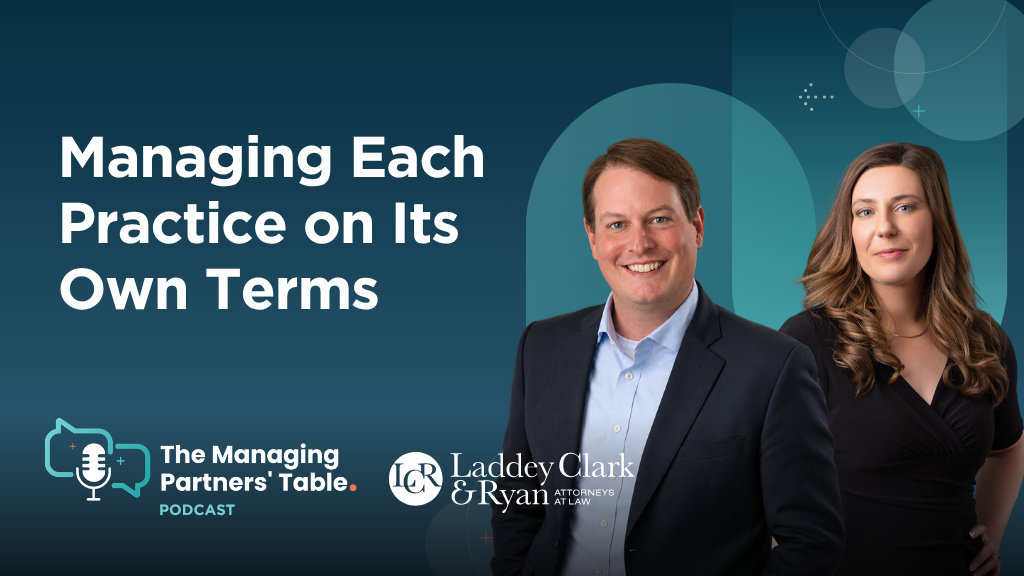
As part of The Managing Partner’s Table, we recently spoke with Tim Dinan about updating how a multi-practice firm measures work, structures matters, and plans for growth. Here are the key takeaways.
A firm-wide revenue total can tell a managing partner whether money came in. But it can’t always explain which types of work are profitable, where staff time is going, which referral sources are producing useful matters, or whether one practice needs a different process.
That difference here has become central to Tim Dinan’s strategy as managing partner of Laddey Clark & Ryan, LLP. The firm handles personal injury, workers’ compensation, trusts and estates, employment, business, land use, and other matters, and each is distinct when it comes to revenue, client acquisition, and staffing.
Modernizing the firm has therefore started with a more precise question: What information and workflow does each practice actually need?
Start with economics
When Tim moved into firm leadership, the reporting systems had changed little from those used when the firm began more than 30 years earlier. Attorneys and practice areas were often being assessed in similar ways, even when the economics differed significantly.
Personal injury revenue, for example, can be uneven from month to month. Other practices may provide steadier revenue but without the same peaks. Flat-fee matters, hourly work, and contingency cases also require different ways of evaluating attorney time, paralegal cost, expenses, and eventual revenue.
To address these differences, the firm began producing monthly reports that show matters opened and closed, revenue generated, origination, and referral sources. After roughly a year of collecting that information, the team is beginning to compare what each practice brings in, where the work comes from, and whether the fees reflect the time and resources involved.
Break a broad practice into its actual lines of work
A single practice label can still conceal meaningful differences.
Tim described his firm’s trusts and estates group as several practices within one department: planning, administration, litigation, and guardianships. Estate planning may involve a higher volume of flat-fee work. Administration and litigation may generate hourly work and arrive through different referral paths.
Evaluating these categories separately can help the firm assess whether its fees reflect the time required, which types of matters produce sustainable work, and where clients are coming from.
That doesn’t mean every firm should use the same categories or reach the same conclusions. The practical step is to separate a broad practice into matter types that differ in pricing, staffing, or referral source, then review each one separately. Otherwise, strong results in one part of a practice can obscure pricing or capacity issues in another.
Adapt workflows to the firm’s actual scale
The same principle applies to process design.
Tim had attended a presentation explaining how a much larger personal injury operation divided matters between pre-litigation and litigation teams. The insights were useful, but the other firm’s scale did not resemble their own firm.
Rather than copying it, the team reassigned paralegals and adapted the basic model to its case volume. The revised structure helps the firm identify earlier whether a case should move into litigation, be resolved, or receive another decision.
Tim said the change has helped matters move more quickly, improved client involvement, and positioned the practice to handle additional cases. Those results came from translating the model, not importing it unchanged.
Connect marketing decisions to matter economics
The firm is also shifting from a history of institutional work toward more consumer-facing practices, including personal injury, workers’ compensation, and trusts and estates. That makes client acquisition and web visibility increasingly important.
From FocusWorks’ perspective, this is where operational information and marketing need to work together. Before investing in greater visibility, a firm should know which matters it wants more of, where those matters come from, and whether the team has the capacity to handle them well.
Tim’s team is comparing attorney referrals with matters acquired directly through marketing. It is also watching how AI-influenced search results affect visibility and how clients arrive with expectations about value and process.
That information gives the firm a clearer basis for deciding what to promote, where to invest, and whether its intake and staffing can support the work that follows.
Treat modernization as ongoing management
Updating a multi-practice firm is not one software installation or one reporting project. It requires leaders to collect useful information, distinguish among types of work, adapt outside ideas, and refine processes as the evidence develops.
Tim has learned to establish a strong foundation before announcing a new initiative. A long gap between announcement and rollout gives uncertainty and hypothetical exceptions time to shape the conversation.
The goal isn’t to eliminate every exception before starting. It is to give the team a usable process, observe what happens, and make decisions from actual experience.
Watch or listen to the complete conversation with Tim Dinan on The Managing Partner’s Table for more on the reporting, workflows, and client-acquisition decisions shaping Laddey Clark & Ryan.
📩 One big takeaway from every conversation, plus what’s working for firms right now → https://www.linkedin.com/newsletters/the-managing-partners-brief-7514343572683534337
🎧 Listen on Spotify: https://open.spotify.com/episode/0sveEAeq84aSWHcntDHnMB?si=Tqfv0lI9R3OS1yJCwEe8QQ
🎧 Listen on Apple Podcasts: https://podcasts.apple.com/us/podcast/ep-3-modernizing-a-multi-practice-firm/id6817930742?i=1000797605003
📬 Get more FocusWorks insights in your inbox → https://mailchi.mp/focusworks/email-newsletter-sign-up
🎥 Watch the full episode here → https://youtu.be/UDSIHL1p00M